Airline Catering and Airport Lounges: Ceramics Under a Weight Limit
- Share
- Issue Time
- Sep 26,2026
Summary
An aircraft galley puts a hard number on every gram, and an airport lounge serves thousands of cups with no commercial dishwasher behind it. Both run ceramic programmes against constraints a restaurant never sees.
The Problem: Two Operations, One Supply Chain
Airline catering and airport lounges are bought by the same buyers but run on opposite constraints. On board, everything is measured: a trolley has fixed compartments, a galley has limited stowage, and every kilogram is fuel. On the ground, a lounge serves a very large number of covers through a long day with a service model closer to a café than to a restaurant. Ceramic programmes in this channel therefore hinge on four specifications.
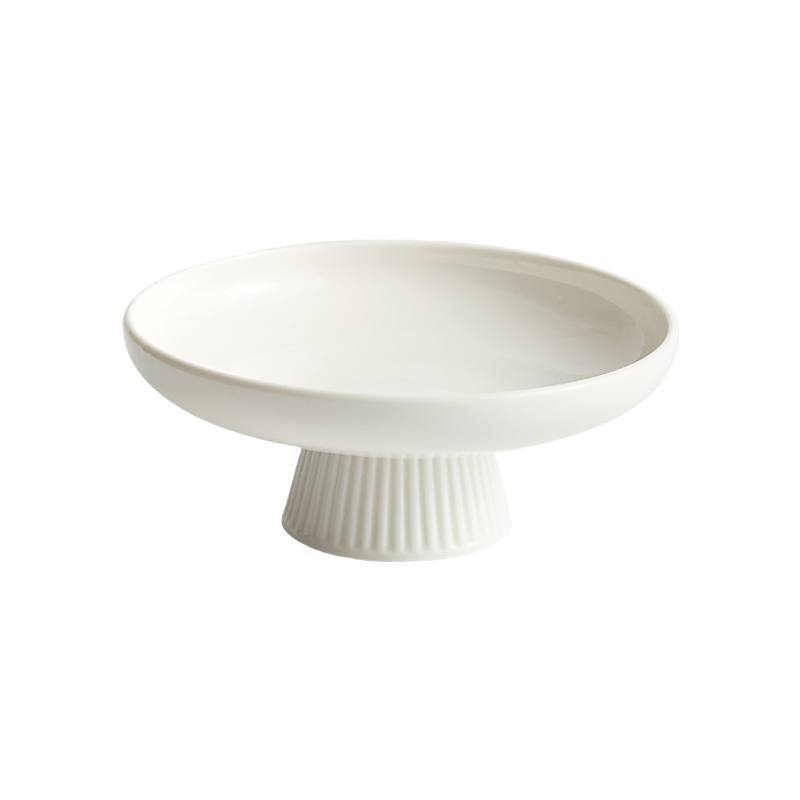
Products in this guide: Japanese Style Ceramic Pedestal Dish for Appetizers & Desserts · White Ceramic Sushi Plate
Four Specifications
Weight, as a figure rather than a principle. Replacing a single-use item with ceramic on an aircraft changes the aircraft's payload, and the trade-off is not only cost: it is the weight of every tray, multiplied by sectors. A reusable programme works where the piece is light for its size and where the weight is offset by smarter stowage — which is a different brief from a restaurant, where weight signals quality.
Standard trolley and tray dimensions. Airline service uses standardised trolleys and trays. A piece that does not seat in the standard tray will not be used, regardless of how good it looks. The specification is therefore the footprint and stack height against the trolley in use, tested with the actual insert rather than assumed.
Thermal shock, from both directions. Catering is chilled and then reheated, and the surface goes from a cold cart to a hot oven and then to a passenger. That cycle is harder on glaze than a dishwasher; thermal-shock testing on the specific item is what matters, and the decoration must be fired — a surface print will not survive the cycle or the sanitation regime.
No-glass policy, stated as a rule. Many operators require that nothing glass goes into the cabin or into certain lounge areas. That is the single strongest reason to use ceramic, and it should be written into the brief explicitly — because it also decides the rim profile (no thin, chippable edges) and the foot design (no sharp rings).
The Lounge Case: Volume Without a Commercial Kitchen
An airport lounge is a high-footfall, low-dwell service: cups and glasses are used, returned and washed continuously, and the back-of-house is small. The practical requirements are nesting height, a body that survives a domestic-scale wash cycle repeated all day, and a decoration that still reads after a year — because lounges are branding environments and the cup is part of the signage. Where a lounge runs a reusable programme, the same loss arithmetic as a stadium applies: a single-piece replacement price and a known loss rate decide whether the programme pays.
Stowage and Replacement Logistics
Airline programmes are replenished at hubs, often on tight turnarounds, and a broken piece cannot be replaced at 35,000 feet. Two items belong in the contract: the specified float carried at the hub, and the single-piece reorder capability from the same body and glaze. Both are the same provisions a cruise operator needs, at a different scale.
Questions to Ask a Supplier
- What is the fired weight per piece, and how does it compare with the single-use item it replaces?
- What is the footprint against our standard trolley insert, and what is the stack height?
- What thermal-shock testing has been run, at what temperature differential?
- Is the decoration fired, and does it survive a sanitation cycle?
- For a lounge: what is the tested dishwasher cycle count, and the nesting height?
- What float and single-piece replacement terms can you support?
The spec freeze guide explains how artwork and packing files are locked between orders.
What to Put in the Order
- Weight per piece, against the single-use item it replaces.
- Footprint and stack height, tested with the real trolley insert.
- Thermal-shock requirement, with the temperature differential.
- Fired decoration, stated as mandatory.
- Nesting height and wash-cycle count for lounge ware.
- Float and single-piece reorder terms.
The packaging guide explains how retail-ready and protective layers are specified together.
The Habit That Ties It Together
The habit is to specify against the trolley and the oven rather than the table. Operators that do this get a reusable programme that survives the cycle, seats in the standard insert, and does not quietly add fuel cost to every sector.
Related Products
Explore products featured in this guide:


Have questions? See our Sizes & Finishes FAQ and Ordering & Certifications FAQ.
Need a custom quote? Send an inquiry or browse our full product catalog.