Capacity and Fill Line: How to Define the Number Everyone Quotes Wrong
- Share
- Issue Time
- Sep 21,2026
Summary
A mug sold as 11 ounces is rarely 11 ounces to the brim, and the fill line it is measured to is almost never written down. This is why capacity drifts, how to measure it, and how to specify it so a second order matches the first.
The Problem: Three Capacities, One Number on the Label
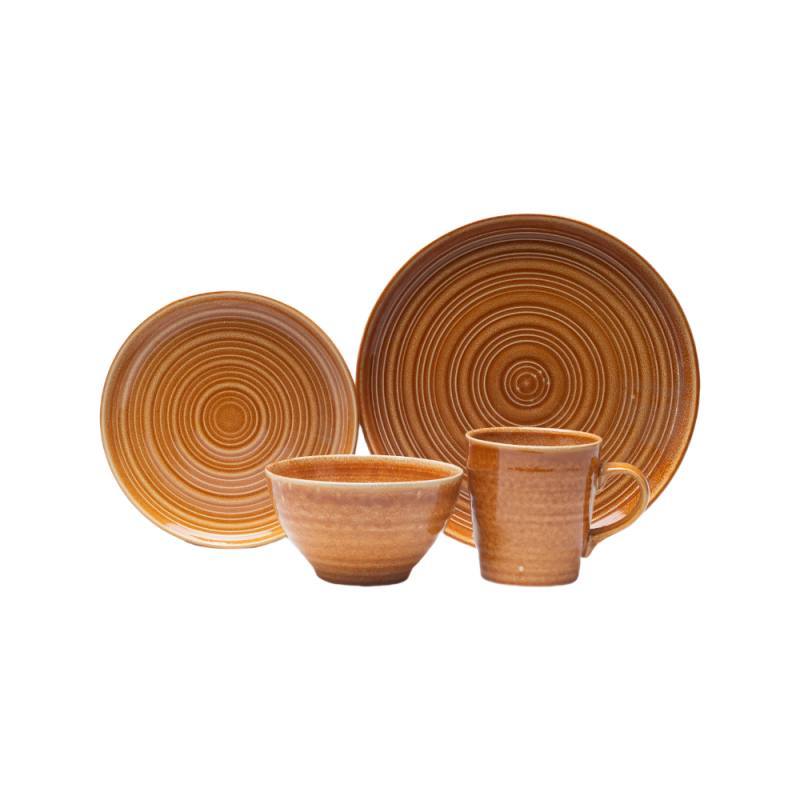
Ask three people what an 11-ounce mug holds and you will get three answers: the volume to the brim, the volume to a line just below the rim, and the volume a person actually pours. All three are legitimate, they differ by ten to twenty per cent, and only one of them is on the specification — usually without saying which. The consequences are ordinary and annoying: a buyer who ordered a replacement finds the new pieces hold slightly less, a lid no longer seats, a stack of mugs no longer nests to the same height, and a customer notices the cup looks smaller than the one they bought last year.
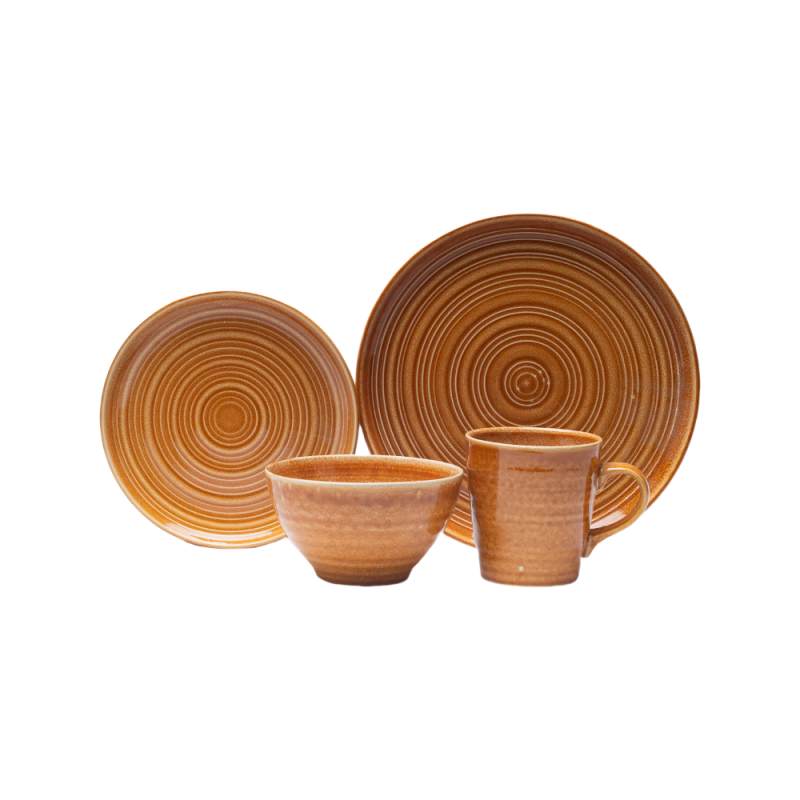
Products in this guide: Vintage Caramel Brown Stoneware 4-Piece Set · Ceramic Salad Plates
The Three Figures, and Which to Specify
Brim capacity. The volume to the very top, filled level. Easy to measure and rarely useful, because nobody fills a mug to the brim.
Practical fill. The volume that can be poured or drunk without spilling in normal use, measured to a line a defined distance below the rim. This is the figure a customer experiences, and the one most worth specifying.
The fill line. The horizontal level used for measurement, expressed as a distance below the rim — a few millimetres, typically. Without it, two inspectors measuring the "same" capacity will produce different numbers, honestly.
The practical recommendation: specify both figures — brim and practical fill — with the fill line distance stated, and require the label or catalogue figure to name which one it is.
How to Measure It
Fill with water to the designated line, at a stated temperature (the difference is small but it exists), then either weigh the water or pour it into a graduated vessel. Weighing is more accurate: one gram of water is one millilitre, and a kitchen scale reads to a gram.
Repeat on several pieces from the batch — five is enough — and record the range rather than a single figure, because capacity varies slightly piece to piece.
Compare against the retained standard, not against a number in isolation. The standard piece is the one the buyer approved; the measurement is how far production has drifted from it.
Why Capacity Drifts
Four causes, all of them normal.
Body changes. Composition affects shrinkage, so a change of clay or blend changes the final capacity even when the mould is untouched. This is the most common hidden cause.
Wall thickness. A thicker wall means less internal volume in the same outer form. Thickness varies with forming pressure, moisture and operator, which is why capacity and weight are worth checking together.
Firing. Higher firing temperatures increase shrinkage; a kiln running hotter than usual produces slightly smaller pieces.
Mould wear. A plaster mould wears over its life, and the pieces formed in it change dimensionally. A long production run on a single mould will drift.
What to Specify
Four lines.
- Brim capacity and practical fill, both, with the fill line distance below the rim stated in millimetres.
- A tolerance, expressed as a percentage — and stated by the buyer rather than assumed, because the acceptable range depends on whether the item is sold by capacity claim or merely by appearance.
- The measurement method: water filled to the line, weighed on a scale, on a stated number of pieces, recorded as a range.
- A change-control link to the body: any change to the body or its source requires re-verification of capacity, because that is how the drift usually arrives.
Where the item has a lid, a stacking feature or a nest height — anything that depends on dimension — capacity should be specified together with those dimensions rather than separately, since they move as a set.
The spec freeze guide explains how artwork and packing files are locked between orders.
What to Ask a Supplier
Five questions, all answerable.
- Is the capacity you quote brim or practical fill, and what fill line is it measured to?
- What tolerance do you hold, and how do you check it — how many pieces, with what instrument?
- Has the body or its supplier changed in the last two years?
- How much does capacity vary across a batch, and across the mould's life?
- If we order this again in a year, what keeps the capacity the same?
The Buyer's Test at Arrival
One practical check takes ten minutes per shipment: weigh a filled piece at the agreed fill line on a scale, on five pieces, and record the range. A piece consistently light, or a range wider than the stated tolerance, is a finding worth a question — and the data behind it is the retained standard rather than an opinion.
The packaging guide explains how retail-ready and protective layers are specified together.
The Habit That Ties It Together
The habit is to write down which capacity is meant, and to measure it the same way every time. Programs that do this avoid the slow drift that nobody notices until a customer does.
Related Products
Explore products featured in this guide:

Have questions? See our Sizes & Finishes FAQ and Ordering & Certifications FAQ.
Need a custom quote? Send an inquiry or browse our full product catalog.