From Design Brief to Production: The Artwork Conversation That Prevents Rework
- Share
- Issue Time
- Sep 10,2026
Summary
Most custom ceramic problems are decided before the kiln — in the files and conversations that translate a design intent into production instructions. This guide maps the brief, the proof chain and the freeze that keep a decorated order matching its concept.
The Problem: Design Intent Doesn't Travel by Itself
A brand team finalises a design on a screen. It looks right: the wordmark sits cleanly, the pattern reads at a glance, the colour is exactly the brand colour. Somewhere between that screen and a kiln in Hunan, that intent has to survive translation — into files, into a decal printer's interpretation, into a glaze that behaves differently from a monitor, and finally onto a curved surface that distorts everything printed flat. When the result arrives wrong, the post-mortem almost always finds the same thing: a decision that was never actually made explicit, and a proof step that was skipped because everyone assumed the other side understood. The fix is not more email. It is a brief complete enough to be produced, and a proof chain disciplined enough to catch each interpretation before it costs money.
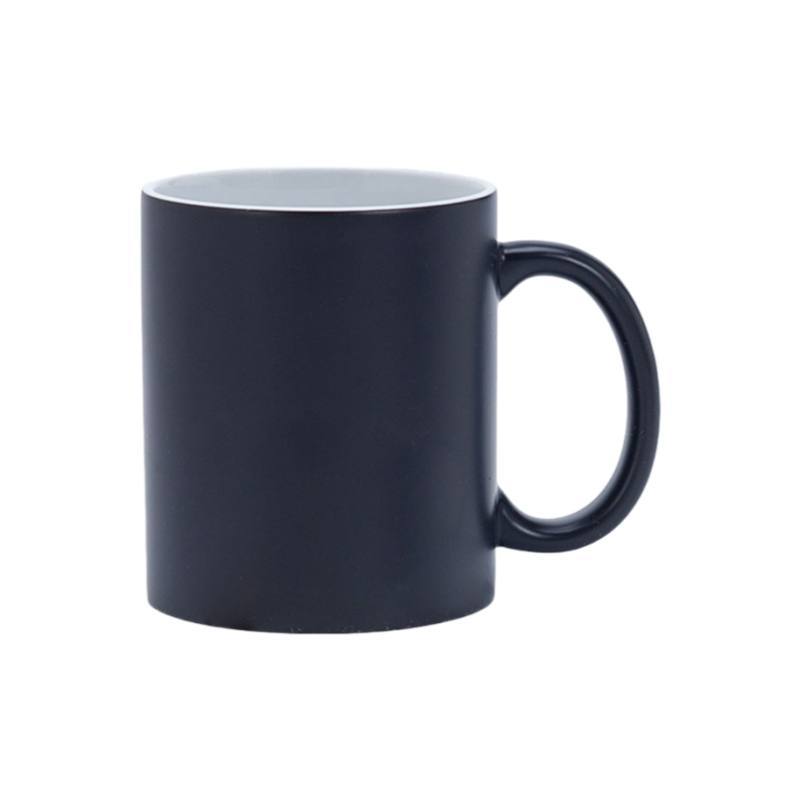
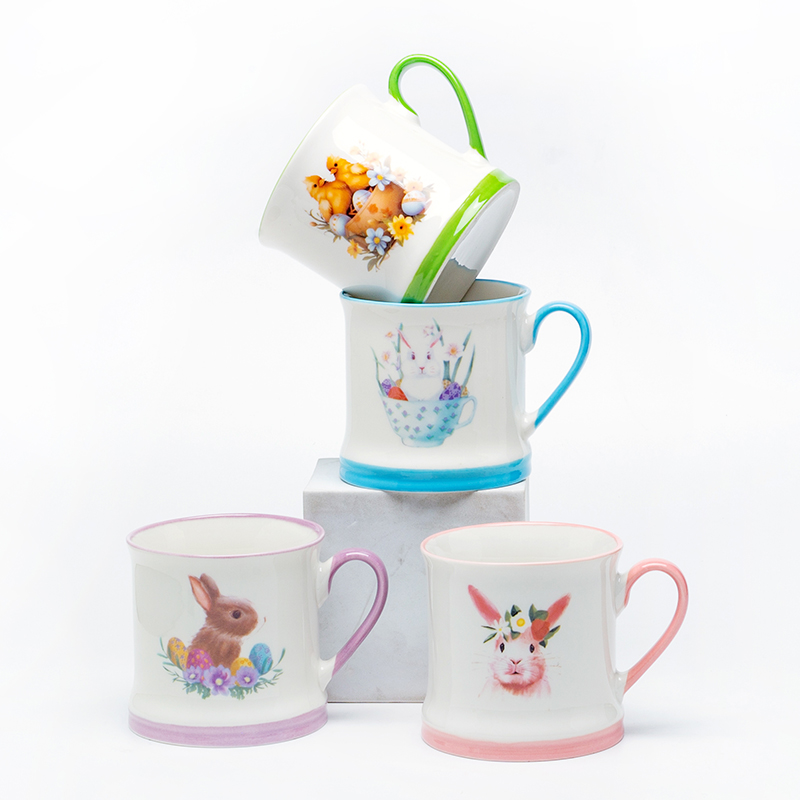
Products in this guide: 11oz Sublimation Magic Mug · Ceramic Decal Printed Rabbit Animal Ceramic Coffee Mugs - Cute Bunny Pattern
What a Complete Brief Actually Contains
A brief that can be produced without guessing covers eight things. The use case: a retail gift mug and a café workhorse impose different constraints, and the factory plans differently for each. The base item: body, shape, capacity, handle style, and whether it is an existing mould or a new one. Dimensions and tolerance: not just the nominal size but how much variation the buyer accepts. Colour, given both as a reference system value and as a described direction, because glaze and decal colour are physical outcomes, not screen values. The decoration method and what it must survive: dishwasher cycles, microwave use, retail handling. Placement: where the design sits, its size relative to the piece, and how it behaves where the surface curves away from the print plane. Artwork files supplied at production resolution, with layers intact and fonts outlined — this single habit prevents more rework than any other. Packing artwork: the inner box, sleeve or label, if the design extends into the packaging.
Decoration Methods and What Each Tolerates
Different methods carry different limits, and the brief should name the one intended. On-glaze decals sit on top of the fired glaze and offer wide colour range and fine detail, with durability that depends on firing conditions — which is why the usage claim must be matched to the method. In-glaze decoration fuses into the glaze itself and is more resistant to wear and dishwasher cycles, with a smaller colour palette and softer edges. Silk-screen printing suits flat, repeating and logo work, with each colour a separate pass — which makes fine gradients expensive. Laser engraving marks the surface physically and is monochromatic by nature; embossing and debossing change relief rather than colour. The practical rule: the more detail and colour freedom a design wants, the more likely it is a decal — and the more likely colour must be judged on a physical proof rather than a screen.
The Proof Chain: Artwork, Decal, Sample, Approval
Production ceramics are approved through a chain, and each link is cheap relative to the one after it. Artwork proof: a flat layout checked for bleed, resolution and text accuracy. Decal or print proof: the printer's colour output on the actual material, which is where gradient banding and small-text legibility get exposed. Sample: the proof applied to the real piece and fired, showing how the surface, the curvature and the glaze interact with the design. Production approval: sign-off that locks what has been seen and tested. Skipping a link does not remove the cost; it moves it downstream, where a correction costs tooling, materials and a production slot instead of an email and a day. Buyers who insist on seeing the fired sample before approving are not being difficult — they are using the only step that shows the truth.
The Freeze and the Change Rule
Once approved, the files and the specification freeze, and changes after that point follow a versioned path rather than a verbal one. The spec freeze guide explains how to lock artwork and packing files between orders. The reason is not bureaucracy. A late artwork tweak touches the decal supplier, the printing plate or file, the sample record and the packing artwork, and each of those has a lead time. The professional structure is simple: the freeze defines what is being produced, and any post-freeze change is dated, costed and re-proved. Programs that handle changes this way rarely experience "the factory printed the old version" — because there is no ambiguity about which version is current.
Bringing the Factory In Early
The most economical moment to involve production is while the design is still malleable. A factory that sees the artwork at brief stage can flag that a gradient will break on a curved surface, that a hairline will fill in during firing, that a colour will not reach the requested depth on the chosen body, or that a placement sits where the handle interrupts it. The new product development guide explains how a design becomes a producible item. None of those observations cost anything at that point; all of them cost a cycle later. It also clarifies who owns which decision — a distinction that sits at the heart of the customisation model. The ODM-to-OEM guide explains which customisation level fits your stage.
Where This Fits in the Sourcing Chain
The artwork workflow sits between the specification that freezes design intent The spec freeze guide explains how to lock artwork and packing files between orders. and the sample that becomes the physical reference for every later batch, The master sample guide explains how sealed references keep batches identical. and it feeds directly into the acceptance routine. The AQL baseline guide explains how acceptance levels are set and written down. The full chain follows the standard sourcing map. See the full ceramic sourcing process map.
The Habit That Ties It Together
The habit is to treat the brief as a document the factory could produce from without a single clarifying call, and to approve nothing that has not been seen fired on a real piece. Decorated ceramics are a translation business. Programs that brief completely and proof in sequence get the design they imagined; programs that communicate by reassurance get the design the kiln decided.
Related Products
Explore products featured in this guide:
Have questions? See our Sizes & Finishes FAQ and Ordering & Certifications FAQ.
Need a custom quote? Send an inquiry or browse our full product catalog.