Glaze and Body Fit: Why Crazing and Shivering Happen, and How to Prevent Both
- Share
- Issue Time
- Sep 20,2026
Summary
Two defects — a web of fine cracks in the glaze, and glaze flaking off the rim — come from the same root: the glaze and the body expanding at different rates. This is the mechanism, the tests, and the specification language that prevents it.
The Problem: A Defect That Appears Six Weeks After Delivery
Crazing is a network of fine cracks in a glaze that looks intact on arrival. Shivering is the opposite: glaze that lifts and flakes, usually at rims and edges. Both are classed as defects in almost every buyer's standard, both are commonly blamed on handling, and both are almost always decided long before the goods were shipped — in the relationship between two materials that were never specified against each other.
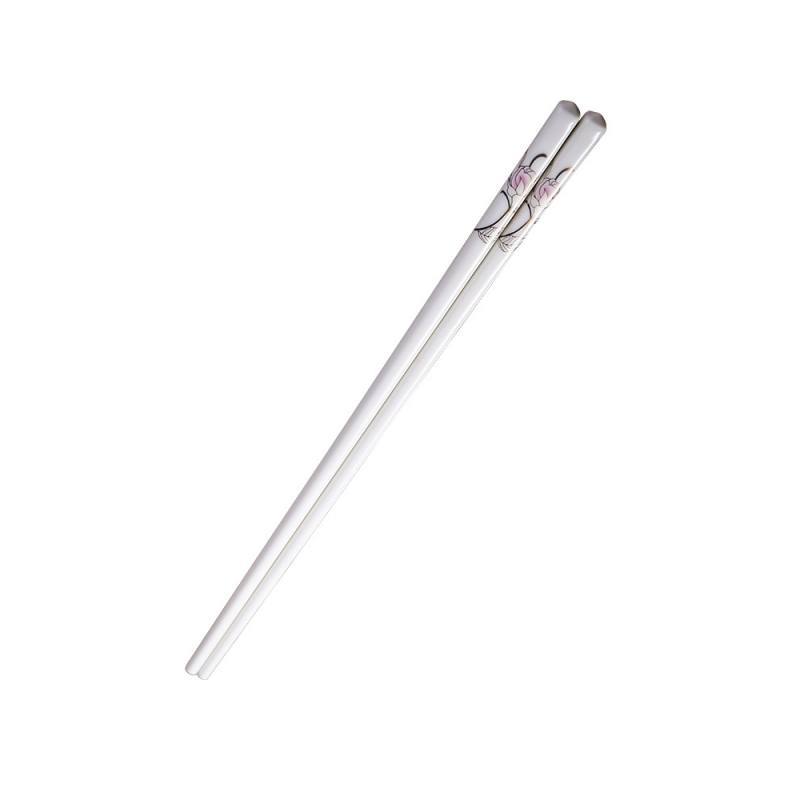
Products in this guide: Elegant Ceramic Chopsticks With Floral Patterns · Vibrant Ceramic Chopsticks Set
The mechanism is thermal expansion. Ceramic and glaze are two different materials fired together; as they cool, they shrink by different amounts. If the glaze shrinks more than the body, it ends up in tension and relieves that tension by cracking — crazing. If it shrinks less, it ends up in compression, and the glaze lifts away at the weakest point, which is normally an edge — shivering. Getting the balance right is called fit, and a well-fitted glaze is slightly in compression: the body shrinks marginally more than the glaze, which is why a correctly made rim feels smooth rather than fragile.
Why It Matters Commercially, Not Only Technically
Three reasons make this worth an article of its own.
A crazed glaze is a hygiene and compliance question. Cracks in a glaze provide a place for residue and bacteria to sit, and in food-contact scrutiny a crazed piece is treated as a defect even where the glaze itself is compliant. For a mug used for hot drinks — repeated thermal cycling — this is a functional failure, not only an aesthetic one.
The failure arrives late. Because a crazed glaze can look perfect on the day of inspection and appear after a few weeks of use or a few dishwasher cycles, it defeats arrival inspection entirely. It will surface as a complaint in the market, which is the most expensive place to find it.
It is invisible in a specification. A specification that states capacity, weight, material and care requirements says nothing about fit. Two suppliers can produce a mug that meets every listed requirement and only one may have a glaze that survives ten years of tea.
What Actually Decides Fit
Four variables, and a buyer can ask about all four without a laboratory.
The body's expansion behaviour. Porcelain, stoneware and earthenware sit in different ranges, and a body reformulated for cost — a change of clay source, a different percentage of a filler — shifts its behaviour. This is the single most common hidden cause: a body change made to save money, with the glaze left untouched.
The glaze recipe's expansion behaviour. Glazes are adjusted with silica, alkalis and other oxides, and each adjustment moves the expansion figure. A factory producing several glazes from one base can produce one that fits and one that does not on the same body.
Firing temperature and the cooling curve. Fit is developed during firing and, critically, during cooling. A faster cool-down leaves stresses that a slower one relieves. Two factories can use the same body and glaze recipes and produce different results because one cools in eight hours and the other in fourteen.
Thickness. A thicker glaze layer stores more stress and fails sooner. Where crazing appears only on certain areas of a piece, thickness variation across the surface is usually the reason.
The Tests and the Evidence
Four practical checks, from the least to the most formal.
The boiling water and dishwasher test. Fill the piece with boiling water, empty, repeat; then run several dishwasher cycles. On a poor fit, crazing appears within a small number of cycles. This is the test that most closely reproduces what a customer will do, and it is the one worth running on every new body or glaze.
The stain test for crazing. Apply a strong colourant — a solution of ink or a strong tea — leave it for a few minutes, then rinse. On a crazed glaze, the colour remains in the crack network and the pattern becomes visible. This is the fastest way to detect crazing that the eye misses under a spotlight.
The rim and edge inspection for shivering. Run a fingernail or a soft cloth along the rim and the foot: shivering presents as a sharp or uneven edge, and often as a small flake with a sharp undercut. A magnifier helps; the point is that the defect is tactile before it is visual.
Fired test evidence from the factory. Where a supplier has it, the most useful document is a test report comparing expansion behaviour of body and glaze, or a record of the thermal-cycle test results for the specific item. Where it does not exist, ask for the thermal-cycle result on production samples — the count of cycles completed without crazing — and record it against the item.
Writing Fit Into the Specification
Fit needs three lines in the specification, and they cost nothing to add.
- The body is a specified item. Not "ceramic" but the named body, with a clause stating that any change to the body composition requires the buyer's approval and re-testing. This is the clause that prevents the most common cause of the failure.
- The glaze is a specified item, with the same change-control clause.
- A thermal-cycle requirement: the result of a defined test — for example, a stated number of boiling-water fills and dishwasher cycles with no crazing or shivering — recorded on the sample approval and repeated on production samples at a stated frequency.
Two supporting details are worth adding where the product is used with hot liquid or washed commercially. First, a statement about the cooling curve, at least in general terms, since that is where fit is finalised. Second, a spare capacity note — where the item is part of a set, the buyer needs to know that a replacement piece will come from a compatible body and glaze, which links directly to the open-stock discussion.
Where Fit Is Decided, and Who Owns It
This is the important commercial point: fit is decided at the sample stage and can only be verified by a test that takes time. A buyer who approves a sample after twenty minutes with a cup of tea is approving appearance, not fit. The practical allocation of responsibility is therefore:
- The factory owns the body and glaze recipes, the firing and cooling cycles, and the test record.
- The buyer owns the question — asking what the item has been tested against, requiring a thermal-cycle result, and refusing a body or glaze change without re-testing.
- The specification owns the evidence: the named body, the named glaze, and the test result with its date.
The spec freeze guide explains how artwork and packing files are locked between orders.
Buying Behaviour That Causes It
Four patterns, all common, all avoidable.
The body changed to save cost, and the glaze left alone. The most frequent cause. It is a specification change and should be treated as one.
A new glaze colour added to a range. A colour adjustment is a recipe adjustment, and each new colour should be tested on the same body before release.
A second factory used as a backup. Different kilns, different cooling cycles: the same recipes can produce a mismatch. A backup source has to be qualified against the same tests, not merely the same drawings.
A faster cycle to meet a peak. Cooling shortened to gain output is a change to the process with a direct effect on fit, and it is exactly the kind of change that is made quietly in a busy season.
The packaging guide explains how retail-ready and protective layers are specified together.
What to Ask a Supplier
Six questions, in the order that gets to the answer fastest.
- Which body and which glaze are these, by name, and have either changed in the last two years?
- What is the thermal-cycle result for this item — how many hot-fill and dishwasher cycles, and how was it measured?
- How is the firing and cooling cycle controlled, and what would change it during a peak season?
- Where crazing or shivering has appeared before, what was the cause and what changed?
- If a replacement piece is ordered in eighteen months, will it come from the same body and glaze?
- What is your procedure if we ask for a new glaze colour on this body?
The Habit That Ties It Together
The habit is to treat the body and the glaze as one specified system and to demand the test that proves it. Programs that do this sell pieces that survive ten years of tea — and stop meeting crazing for the first time in a customer's kitchen, six weeks after the container arrived.
Related Products
Explore products featured in this guide:


Have questions? See our Sizes & Finishes FAQ and Ordering & Certifications FAQ.
Need a custom quote? Send an inquiry or browse our full product catalog.