Market-Facing Labels and Care Guidance: The Layer Buyers Forget to Specify
- Share
- Issue Time
- Sep 11,2026
Summary
Carton marks move containers; retail labels and care guidance move products — and they decide whether a customer uses the item correctly. This guide covers what belongs on the label, what must be translated, and how to keep versions straight across markets.
The Problem: The Label Nobody Specified
A shipment arrives with correct carton marks, correct documents and correct product — and then sits at the buyer's warehouse because the retail label is missing the origin statement their market requires, or the care insert describes dishwasher use in a language their customers do not read. Labels are the smallest printed component of an order and the last one anyone thinks about, yet they carry three distinct obligations at once: commercial information that makes the product sellable, regulatory information that makes it legal, and usage guidance that decides whether the customer uses it in the way the factory intended. The first two cause holds and returns. The third causes complaints that look like quality failures and are actually instruction failures.
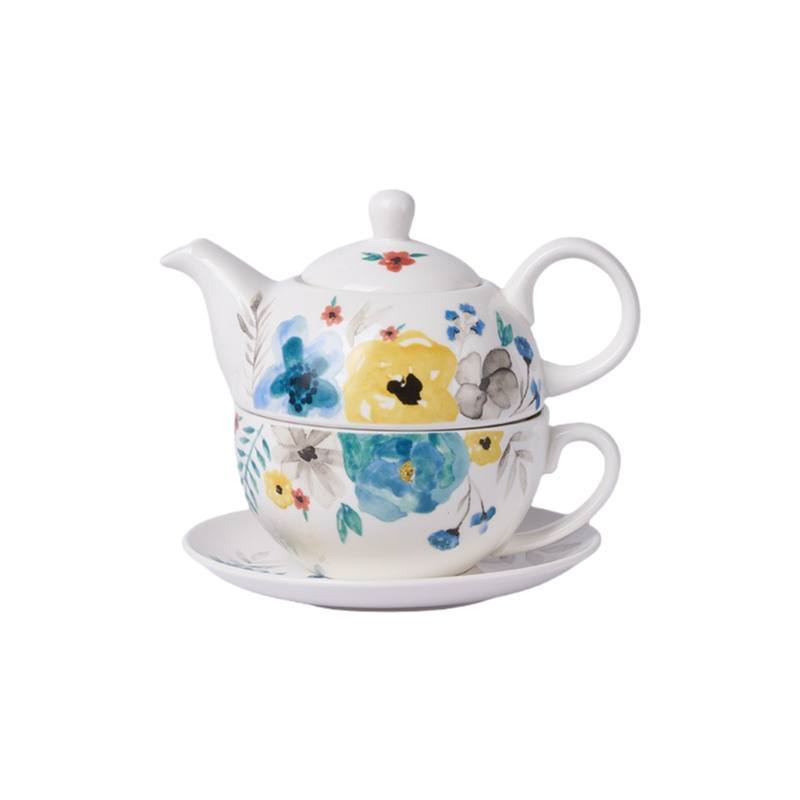
Products in this guide: Creative Porcelain Tea Set · Japanese Style Stoneware Teapot With Infuser Lid
Where This Fits in the Sourcing Chain
Label content belongs to the frozen artwork specification, alongside the product decoration and the carton print. The spec freeze guide explains how artwork and packing files are locked between orders. At the logistics layer, carton marks and transport labels are the counterpart — what the warehouse reads. The carton marking guide explains how marks and labels keep containers moving. And the care guidance is the cheapest available defence against the complaint class known as customer misuse. The complaint-to-corrective-action guide explains how quality issues close the loop. The full chain follows the standard sourcing map. See the full ceramic sourcing process map.
The Three Layers of Label Content
The retail unit label. Whatever the destination market requires on a product sold to a consumer — typically contents, country of origin, material, and care symbols — plus the barcode your channel will scan. Placement is decided early, because a barcode printed over a curve or a handle gap scans badly for the life of the product.
The care and use guidance. Microwave, dishwasher, oven and thermal limits, stated honestly. This is the layer with the highest commercial return per unit of effort: a product described as dishwasher-safe that is not will generate complaints that no inspection can prevent.
The multilingual layer. Where a market requires more than one language, the requirement applies to specified content, not to everything. Establishing which parts must be translated — and which may stay in one language — is a market question with a market answer, and it should be confirmed for the destination rather than copied from another.
The Translation Trap
Three failure modes appear repeatedly in translated labels. Word-for-word translation, which produces text that is grammatically correct and meaningless in the market's own usage. Symbol confusion, where a care symbol is reproduced accurately but means something different to consumers in the destination if the local convention differs. Space constraint, where the translated text is longer than the original and the layout has to be rebuilt — which is why translated labels should be proofed as artwork, not as text. The practical rule: the person who reads the market should approve the label, not the person who writes the language.
Managing Versions Across Markets
Once a product sells in three or four destinations, label management becomes a version-control problem. The workable structure is one master content sheet — product, materials, care facts, barcode data, mandatory statements — with market variants defined as exceptions to it. When a material or care claim changes, it changes in one place, and the affected markets are derivable rather than remembered. And because the label is part of the frozen artwork, any change follows the same versioned path as any other specification change. The spec freeze guide explains how artwork and packing files are locked between orders.
What to Specify in One Order
Five items, agreed before the artwork is signed off: the mandatory statements for each destination; the care facts, stated accurately rather than aspirationally; the languages required and which content each covers; the barcode specification and its placement; and the approval route, naming who signs each market's label. That list takes an hour to settle once and prevents a class of problem that is otherwise discovered at a pallet in a warehouse.
The Habit That Ties It Together
The habit is to treat the label with the same rigour as the product decoration: specified, translated, proofed and frozen. Programs that do this get products that are legal, readable and used correctly. Programs that do not discover that the smallest printed item in the order is the one that decides whether the order was worth shipping.
Related Products
Explore products featured in this guide:


Have questions? See our Sizes & Finishes FAQ and Ordering & Certifications FAQ.
Need a custom quote? Send an inquiry or browse our full product catalog.