Scrap and Grog: Where a Factory's Waste Becomes Your Product's Variability
- Share
- Issue Time
- Sep 21,2026
Summary
Every ceramic factory produces rejects and breakage, and most of it goes back into the process. Handled with a limit and a record it saves money; handled by habit it is one of the quiet causes of shrinkage drift and handle failures.
The Problem: The Cheapest Material in the Factory
Throwing away formed or fired ceramic is expensive — the material has already consumed energy, and disposal costs money. So factories return what they can, and the practice is old, sensible and normal. What varies is whether it is controlled.
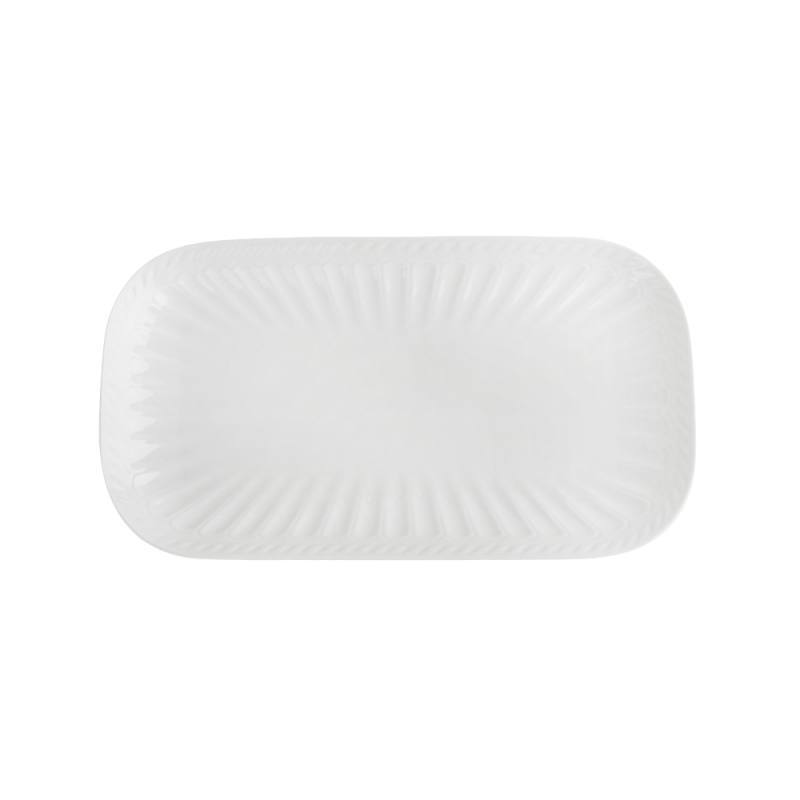
Products in this guide: White Ceramic Sushi Plate · Ceramic Sushi Tray with Built-in Sauce Dish
Uncontrolled reuse changes the body: shrinkage moves, plasticity changes, weight and capacity drift, and handle joints that used to hold start to fail. The defects appear as a wave rather than at random, which is precisely the signature of a body change discussed under clay preparation — and the reason to ask about scrap in the same conversation.
What Can Be Reused, and What It Does
Green (unfired) scrap. Forming rejects and trimmings can be returned to the body after crushing and rewetting. The effect: it is essentially the same material, so the body is consistent — provided the moisture is controlled and the proportion does not creep upward.
Bisque scrap and broken fired ware. This material has been fired, so it cannot become plastic again. Crushed, it becomes grog (chamotte) — a non-plastic filler. Adding grog reduces drying shrinkage and cracking, and changes the texture of the body, which is why some producers use it deliberately and some use it as a disposal route.
Glaze-rejected fired waste. Ware that has been fired and glazed cannot be recycled into the body in any useful way; it is crushed and used as aggregate or sent for appropriate disposal.
The controlling question is proportion. A body with a defined grog content is a body with predictable shrinkage. A body that absorbs whatever the factory produced this month has a shrinkage that moves with the seasonal reject rate — which is a variability nobody can plan around.
The Two Effects a Buyer Feels
Shrinkage and dimensions. More grog generally means less shrinkage, so capacity, lid fit and stack height move. If recovered material enters the body without a limit and without re-verifying capacity, the buyer discovers the change through a slightly different piece.
Plasticity and joints. Grog reduces plasticity, which affects forming and, in particular, how well a handle joint develops. A body that has drifted toward more filler can produce joints that are structurally weaker without looking different.
The Sustainability Dimension
Recycled content is now a marketing and procurement topic, and it cuts both ways. A factory that reuses its scrap can honestly point to lower waste and less landfill. A buyer who wants to state recycled content on packaging needs data to support it — and "we reuse everything" is not data. Where a claim matters, the useful evidence is a measured proportion and a process description, not an adjective.
The reverse also holds: recycled content is not automatically good for the product. A buyer who needs tight dimensional consistency may prefer a body with no recovered material, and a supplier able to offer both — with and without — is a supplier that understands its own process.
What to Specify
Three lines.
- A maximum recovered-body proportion, expressed as a percentage, with the note that a change requires re-verification of capacity and dimensions.
- A grog specification where grog is used: particle size and proportion, so that texture and shrinkage are defined rather than incidental.
- A disclosure requirement for recycled content claims, where the buyer intends to make one.
The spec freeze guide explains how artwork and packing files are locked between orders.
What to Ask a Supplier
Five questions.
- What proportion of the body is recovered material, and is that proportion defined or incidental?
- How is the proportion controlled and recorded?
- If grog is used, what size and what share?
- How much production waste leaves the site, and in what form?
- If we needed to state recycled content on the packaging, what could you document?
The Habit That Ties It Together
The habit is to treat scrap as an input with a specification rather than as a convenience. Programs that do this keep the cost benefit and lose the variability — and can make a recycled-content claim that survives a question.
Related Products
Explore products featured in this guide:


Have questions? See our Sizes & Finishes FAQ and Ordering & Certifications FAQ.
Need a custom quote? Send an inquiry or browse our full product catalog.